Tuesday, July 17, 2018

Building Foundation Guide

Guidelines For designing a foundation of building considering the problems faced in practice

Please follow, Share, Comment, Suggest following page.

Following are the points TO KEEP IN MIND BEFORE FOUNDATION DESIGN

Image result for building foundation work

There are, in foundation design, a number of practical construction problems and costs to be considered.
The chief ones are:

  1. The foundations should be kept as shallow as possible, commensurate with climatic effects on, and strength of, the surface soil; particularly in waterlogged ground. Excavation in seriously waterlogged ground can be expensive and slow.
  2. For heavy underground structure, shoring work design details should be described properly. Stiffness of the structure should be considerable.
  3. Foundation design should be economical & adopt modern technique to reduction in the costs of piling. Ground treatment work should be applied accordingly.
  4. Designers need to be more aware of the assumptions made in design, the variability of ground conditions, the occasional in-applicability of refined soil analyses and the practicality of construction.
  5. Soil investigation report should be made by a experienced Geo-technical Engineer. The assessment report should contain all necessary data..
  6. Effect of construction on ground properties, i.e. vibration from piling, deterioration of ground exposed by excavation in adverse weather conditions, removal of overburden, seasonal variation in the water-table, compaction of the ground by construction plant.
  7. Effect of varying shape, length and rigidity of the foundation, and the need for movement and settlement joints.
  8. After-effects on completed foundations of sulfate attack on concrete, ground movements due to frost heave, shrinkable clay, and the effects of trees; also changes in local environment, e.g. new construction, re-routing of heavy traffic, installation of plant in adjoining factories causing impact and vibration.
  9. Fast but expensive construction may be more economic than low-cost but slow construction to clients needing quick return on capital investment.
  10. Effect of new foundation loading on existing adjoining structures.

Please follow, Share, Comment, Suggest following page.

Civil Engineering Basic Knowledge

Some Basic Knowledges for a Civil Site Engineer to construct a Safe & Quality Structure.
Following points should you remember when you execute the Construction work................
(i) Lapping is allowed for the reinforcement of Dia. upto 36 mm. For larger Dia. of bar, Rebar Coupler should be used.
(ii) Tubular Prop should be checked properly. Spacing of the Props basically 1000 mm. c/c for Slab and 600 mm. c/c for beam bottom.
(iii) Chair or Stool is be placed 1 No/SqM.
(iv) Minimum 12 mm. dia. bar used for provide Chair.
(v) For dowels rod minimum of 12 mm diameter should be used.
(vi) As per IS Code, in case of Beam, Min. Tensile reinforcement should proved as per       Cl.26.5.1.1. i.g. (0.85 Bd/fy) and Max. Tensile reinforcement 4% of c/s area.
(vii) In Beams, Lapping  should not provided at mid-span (in Tension zone) & at support (in Compression zone)
(viii) Main bars in the slabs shall not be less than 8 mm (HYSD) or 10 mm (Plain bars) and the distributors not less than 8 mm and not more than 1/8 of slab thickness.
(ix) Minimum thickness of slab is 125 mm. or 5 inches.
(x) Dimension tolerance for cubes + 2/3 mm.
(xi) Free fall of concrete is allowed maximum to 1.20 m.
(xii) Water absorption of bricks should not be more than 15 %.
(xiii)PH value of the water should not be less than 6.
(xiv) Compressive strength of Bricks is 5 N / mm2.
(xv) In steel reinforcement binding wire required is 7-8 kg per MT.

Thanking you for visit. Kindly like, comment, share my post.

Monday, July 16, 2018

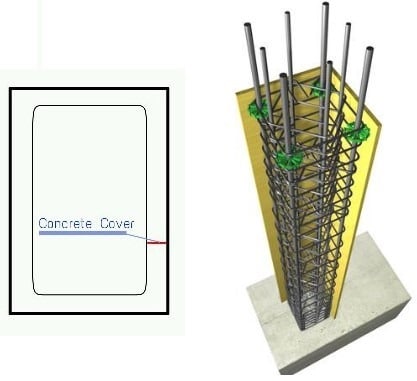
Concrete Cover for R.C.C. Structure

What is concrete cover?

Concrete cover for RCC element is required to protect the reinforcement from corrosion & fire. The thickness of the cover depends on exposure condition and nature of structure.

It is basically provided in the Sec. detail drawing.

Reference I.S. Code : IS 456 : 2000
Concrete Cover Specifications for Reinforcement
Type of structureConcrete over, mm
Concrete cast against and permanently in contact with ground75
Concrete in contact with ground or water
No. 19 through No. 57 bars50
No. 16 bar and smaller40
Concrete not exposed to weather or in contact with ground
Slabs, walls, joists
No. 43 and No. 57 bars40
No. 36 bar and smaller20
Beams, columns
Primary reinforcement, ties, stirrups, spirals40
Shells, folded plate members
No. 19 bar and larger20
No. 16 bar and smaller13

Building Foundation Guide

Guidelines For designing a foundation of building considering the problems faced in practice Please follow, Share, Comment, Suggest follo...